#KUFieldWorks: Understanding corporate giving as legitimacy-seeking behavior
Editor’s note: Fieldwork provides invaluable insights about real-world environments and processes, expanding and reinforcing what researchers learn in classrooms, labs and collections. KU faculty, staff and students across a spectrum of disciplines take their inquiry directly to rivers, prairies, dig sites, glaciers, islands, archives and more. Through the #KUFieldWorks series, we'll join them on their adventures.
Q&A with Jun Ho Lee, assistant professor of business
Corporate charitable donations, known as corporate giving, are motivated by a number of factors. International business researcher Jun Ho Lee aims to better understand this behavior, especially in the context of family-owned Korean companies. He traveled to South Korea to conduct in-depth interviews with decisionmakers and stakeholders associated with these firms to determine these factors.

What methods, approaches, experiments, etc. are you using?
My research combines large-scale quantitative analysis with qualitative insights. I use longitudinal datasets of firms, such as publicly listed companies, to examine how ownership structures, governance arrangements and external actors influence corporate behavior over time. For example, in my work on family firms, I analyze panel data from Korean family companies and apply econometric techniques to identify causal relationships between family ownership and earnings management.
In a related project, I examine how generational shifts in Korean family firms shape legitimacy-seeking behavior. Using firm-level data on corporate giving, I study how later-generation leaders respond to legitimacy challenges by engaging in visible social activities such as philanthropy.
I also complement these analyses with qualitative data, including interviews with corporate managers, journalists and academicians to better understand how Korean family firms interpret and respond to their environment. This mixed-method approach allows me to connect rigorous empirical patterns with real-world decision-making processes.
Why does your study matter to your field or for society?
My research matters because it helps explain when firms behave responsibly and when they don’t. Corporate decisions around financial reporting, social responsibility and disclosure affect investors, employees, communities and broader society.
For instance, my work shows that the same ownership structure — such as family ownership —can either improve governance or enable opportunistic behavior, depending on how control is structured. At the same time, my research on generational change shows that firms are not static: As leadership transitions across generations, firms face new legitimacy pressures and may actively engage in socially visible behaviors, such as corporate giving, to maintain stakeholder trust.
These findings challenge simplified assumptions in corporate governance and provide more nuanced insights for regulators, investors and policymakers. More broadly, my research highlights how both internal structures and external audiences — such as media, investors and stakeholders — serve as governance forces that monitor firm behavior.
What do you enjoy most about being in the field?
What I enjoy most is uncovering hidden patterns in how organizations behave. Firms often present a polished, consistent image; but when you analyze data over time or talk to insiders, you start to see the underlying tensions between transparency and discretion, reputation and performance, or control and accountability.
I also find it fascinating how firms actively manage how they are perceived. Whether through financial reporting or corporate giving, organizations are constantly responding to how stakeholders evaluate them. Connecting these real-world dynamics to broader theoretical ideas like governance and legitimacy is one of the most rewarding aspects of my work.

What are some memorable (funny, scary, surprising, etc.) moments from the field?
One of the most memorable moments comes from realizing how differently stakeholders interpret the same corporate behavior. For example, a practice like earnings management can be seen internally as a strategic tool to maintain stability, while external investors may interpret it as opportunistic or misleading.
Similarly, in studying corporate giving, what appears to be purely altruistic behavior can also reflect strategic responses to legitimacy challenges, especially when new generations take over leadership.
In interviews, I’ve encountered moments where managers candidly acknowledge these tensions, sometimes noting that “managing expectations” can be just as important as managing performance. These experiences highlight how complex and perceptual organizational decision-making can be.
When is fieldwork frustrating, challenging or overwhelming?
Fieldwork can be challenging when the data is incomplete or when key mechanisms are difficult to observe directly. For example, governance processes and family dynamics often happen behind closed doors, so researchers must infer them from observable outcomes like financial reporting or corporate giving.
It can also be difficult to disentangle causality of firms’ behaviors shaped by multiple overlapping factors, including ownership, generational transitions, regulation and market pressures. Ensuring that findings are both rigorous and credible requires careful research design and extensive robustness checks.

How does fieldwork complement the work you do elsewhere?
Fieldwork complements my quantitative research by providing context and interpretation. Large datasets can show patterns, such as when firms increase or decrease corporate giving; but field insights help explain why those patterns occur.
For example, while statistical models reveal that family ownership and generational shifts influence firm behavior, qualitative insights help explain how family members perceive legitimacy challenges, identity and their responsibilities to stakeholders.
These approaches create a more complete understanding of corporate behavior, bridging rigorous empirical analysis with the realities of organizations.
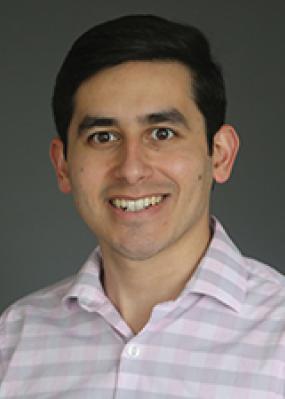
First photo: University of Kansas researchers conduct fieldwork in prairies, rivers, mountains, archives and other settings. The #KUFieldWorks series follows researchers on their fieldwork adventures.
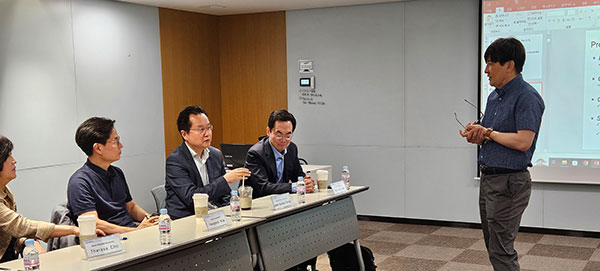
Second photo: Jun Ho Lee presents research and engages in discussion with faculty and practitioners during a seminar session.
Third photo: A university campus building in Korea, where Jun Ho Lee engaged in field research and academic collaboration.
Fourth photo: One of several books on Korean business groups (chaebols) that informed the conceptual development of Jun Ho Lee’s research.