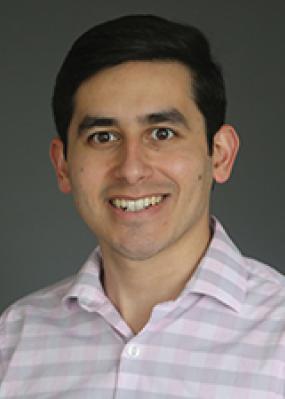
KU postdoc builds community with others

Apoorva Ranjekar | Postdoctoral Researcher | Center for Environmentally Beneficial Catalysis
As a child, Apoorva Ranjekar was captivated by the science hidden in everyday life. He wondered about the "whistling" of a pressure cooker and how it cooked food so efficiently. That youthful curiosity sparked a lifelong passion for technology and engineering, leading him on an academic path from Mumbai to Lawrence, Kansas, where he now works as a postdoctoral researcher at the University of Kansas.
Ranjekar earned a bachelor’s degree in chemical engineering from North Maharashtra University before pursuing a master’s degree in nanotechnology from Sikkim Manipal Institute of Technology, and later a doctorate from the Institute of Chemical Technology, Mumbai. He joined KU as a postdoctoral researcher, first on contract with Archer Daniels Midland and now in the Center for Environmentally Beneficial Catalysis.
At CEBC, Ranjekar uses catalysis — a process of making a chemical reaction more efficient with another chemical called a catalyst — to reduce carbon emissions in energy generation. Specifically, his project involves removing nitrates from groundwater. Electrodes lined with a thin film (the catalyst) are used to convert the nitrate into ammonia, a valuable hydrogen resource, which can be used as an alternative to fossil fuels. Ranjekar’s position is funded by the Defense Advanced Research Projects Agency.
“The primary goal is to extract nitrates from groundwater and then from that nitrate grab hydrogen. That hydrogen can be used for energy purposes,” Ranjekar said. “Some defense installations are in remote places, and they need energy. So if there is groundwater or any water source, you can use that prototype and grab the nitrate.”
Beyond working in the lab, Ranjekar is president of the KU Postdoctoral Association. He and the other officers help organize networking and professional development events, connect postdocs to KU legal assistance, and review travel grant applications. But the biggest benefit of KUPA is that it connects researchers at the same career stage who are dispersed in labs across campus who otherwise would not have opportunities to connect.
“I attended my initial KUPA events and saw that many postdocs didn’t know each other,” Ranjekar said. “At that time, I was working at KU Innovation Park, and a lot of the other labs are near the Innovation Park, but we hadn’t met.”
Connections between postdocs foster information sharing and promote well-being. A postdoctoral researcher in one lab may need to troubleshoot a technical issue that another postdoc has already come across. Others benefit from camaraderie and shared experiences. Unlike graduate students who enroll in courses with others in their cohorts, postdoctoral researchers would not have regular ways of meeting each other if not for KUPA.
“Many postdocs are away from their home country, so they do not have immediate families here. Whatever different networks they find here are their family,” Ranjekar said. “We come together to celebrate. We also come together to share our sadness and sorrows so that it will have less impact on us.”