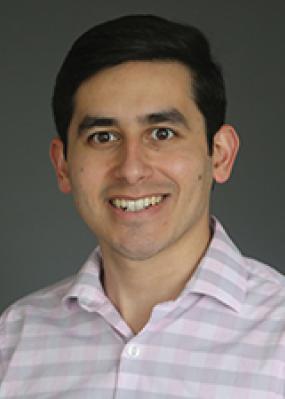
'I’m striving to use innovative technologies to help educators support all students'
University of Kansas faculty are striving to advance knowledge, interpret our world, solve problems, spark innovation, create beauty and catalyze imagination through their research, scholarship and creative activity. Through the “I Am Striving” series, we’ll learn more about what inspires KU researchers, as well as the goals and impact of their work.
Q&A with Amber Rowland, associate research professor at the KU Life Span Institute and Achievement & Assessment Institute
1. Explain your research as you would explain it to someone outside your field, such as your grandparents.
My research is in innovative technology and supporting all students, especially those who struggle, and the professional learning necessary to support the educators who work with them.
2. What does your research look like? What methods do you use?
The research that we do, because it's in innovative technology, we work with teachers and we work with students — so we have to do a mixed method. We're looking at the qualitative aspect, which is really their performance. How well are they responding? For instance, in our extended reality environment, how well are they answering questions? How fast are they doing it? The qualitative aspect is really going to look at how socially acceptable it is. Do they like it? Are they enjoying it? Is it something they're willing to do even after the researchers leave? So that's the qualitative piece, a combination of the two.
3. What inspires your research? Why are you passionate about this work?
In our country, I think children — K-12 children especially — but all kids are our greatest natural resource. It's critical that we provide the supports and resources that educators need to best foster those students. I think every child has a right to participate fully in society. To do that, we really do have to focus on all kids, including those who struggle or may have disabilities. A big piece of the work that I do is working with those children to find the most innovative way to support their learning. So if they haven't found success so far, we want to help them find success through our projects.
I work really hard with educators to understand: What are the pain points? What are the things that keep them up at night? When they go to implement this innovation that we've been working on, we want that to be something that they find a lot of practical application for. It's not just one more thing; it's something that's really going to help their children and themselves do their job.
4. How does your research directly impact your field, society, Kansas and the world?
We travel all over, sharing the different resources and tools that we design. For example, the extended reality environment that we've designed is to support students learning social skills. We know that social skills are prevalent across all learning. You've really got to have social skills to even access the curriculum in K-12 education right now. That's a huge piece of what we do. That can help any kid anywhere who needs to work on social skills. We found a lot of students post-Covid, but also even now with all the gaming that's happening, students don't have the same opportunities to go out and do social skill practice naturally. We have so many different people — psychologists, psychiatrists, all sorts of related service personnel like speech language pathologists and occupational therapists, etc. — who really need something to help the students implement the strategies that they practice with them. It’s the same thing with teachers in general and special education. Students need some way to practice the social skills that they're learning in the classroom, and this is a safe way to do that.
5. What is a recent study/example of work you’d like to share?
VOISS is a virtual reality environment that gives students the opportunity to learn and practice social skills. Within that setting, we have about 183 social skills and 142 different scenarios that kids can go in and play, and it gives them a safe place to do that. Usually in the classroom, when you're teaching social skills — or even out in the world when you're helping a student learn a social skill — you typically have to engage other people to do so. You're outing them to their peers, telling them, “Oh, this person has a social skill deficit, and we need to help them.” We're going to train educators in how to help this kid. So all of that comes together, especially for a student who struggles — like a student who has autism would really struggle with the social implications of that method of supporting them. That's not to say that that's not appropriate and it doesn't need to happen. But the cool thing about VOISS that we have right now is that students can learn and practice a social skill initially, before they then go out and generalize.
The second iteration of VOISS we're calling iKNOW, and it's what we're currently developing. VOISS had buttons that students could push to respond naturally to social skill situations, whereas iKNOW is going to have artificial intelligence. Now the students can go back and forth and actually talk to the avatars as though they are middle school students, and they will respond in kind. It's a whole new layer or level of social skill practice. We like to think about VOISS as a scaffold. Students need to learn the social skill, practice it, and have the opportunity to really think about it. Then iKNOW is going to have some of the next levels where you actually have to naturally go back and forth and speak, and artificial intelligence is letting us do that.
6. What do you hope are some of the outcomes of your research and work?
We want every kid who needs social skill practice to have access to VOISS and/or iKNOW, and that would be the ultimate best aspect of the work that we do. I just got to go out and talk to several different schools last week with the Department of Education in Hawaii. Before that, we were in Denver at a school that has middle school students who are neurodiverse. They weren't successful in the public schools, but they were able to come to this charter school and focus together on social skills. In talking with those kids, I've had several of them say, “I've been using VOISS for 10 weeks. Last year I used to get in a lot of fights because I didn't know the words to use to get out of a situation, but VOISS taught me how to talk to other people. It taught me how to recognize people's emotions and to use the words I need to use in order to avoid a confrontation that I've been having.” Or one student said, “When I first came to school, I didn't talk to anybody; but VOISS helped me figure out the words I needed in order to start a conversation or join a group.”
Those are all the social skills that we cover in VOISS, and eventually iKNOW as well. That is the ultimate success of that particular line of research. It’s that every kid has the opportunity to learn and practice those skills and feels more confident in going out and doing these jobs that don't even exist yet because we know that that's what humans bring to the table is social skills and the ability to collaborate and communicate. That's the part that a lot of kids right now are really struggling with for various reasons in our society. I think VOISS fills that niche and gives educators and related service providers an opportunity to practice it.
Tagline: I'm Amber Rowland. I am an associate research professor with the KU Life Span Institute and the Achievement & Assessment Institute. I’m striving to use innovative technologies to help educators support all students, especially those who struggle.