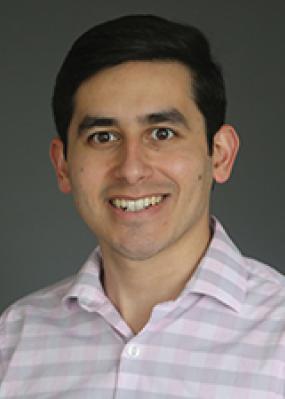
'I am striving to always answer questions in the most innovative and thoughtful ways possible'
University of Kansas faculty are striving to advance knowledge, interpret our world, solve problems, spark innovation, create beauty and catalyze imagination through their research, scholarship and creative activity. Through the “I Am Striving” series, we’ll learn more about what inspires KU researchers, as well as the goals and impact of their work.
Q&A with Steve Bien-Aime, assistant professor of journalism
Explain your research as you would explain it to someone outside your field, such as your grandparents.
My research area is somewhat eclectic in a way, but the way I would describe it would be I look at primarily journalism through a wide range of perspectives. So I look at media representation. How do we talk about different issues? How do we talk about different groups? Whose perspectives are included? Whose perspectives and experience are not included, or how are they shaped? This would be the biggest area that I would look at primarily in news and sports media. I also look at journalistic practice, meaning what are some theories behind how journalists are using social media? How does journalism intersect with artificial intelligence to see how we can do better in our industry? And I say our industry, because I worked professionally in journalism.
What does your research look like? What methods do you use?
I come from a text-based background, so I do a lot of looking at newspapers and not just in the United States. We've done comparative projects in Japan, the U.S., Europe and China. We have a paper under review right now looking at newspapers in Great Britain versus newspapers in South America. We tend to take what we would call a comparative approach — not just how are we covering things here, but how are the same issues covered in other places to try to get a more comprehensive view.
In terms of journalistic practice, I work with experimental scholars. So I bring a practitioner's perspective and I'm knowledgeable of the theories, but my coauthors are far better on the need to control for this variable when you're asking people about these experimental conditions. So we try to look at what are the reasons behind why we think the way that we think.
What inspires your research? Why are you passionate about this work?
At its heart, I'm a journalist, so there are questions that need to be answered. If students bring up something in class, "OK. That's interesting." I think there should be a humility and a fearlessness to research. You have to be humble enough to understand you don't know everything. You're not an expert in everything, but have a dogged determination that I can answer these questions, or I can call upon enough people to put together one of those Avengers-type teams or the Justice League or whatever you want to call it, to really answer important questions and really make a contribution.
How does your research directly impact your field, society, Kansas and the world?
From a media representation perspective, I look at the impact through language use. You can see different things about how newsrooms are responding to all of this. Should we be using this terminology? Is this something that is distracting our readers from the important things we're trying to tell? And we can see that through engagement at conferences and emails we get and different things, and that's heartening to see that the industry wants to take a back step.
Journalism is an incredibly difficult job. And so at times, I think people are a little bit too cynical about the motivations behind why something looks the way that it does. And being in this job, I'm not encumbered by the day-to-day difficulties of being understaffed, underpaid and overworked. And so in that setting, my mentality is, "I'm just trying to get to the next day; I'm trying to get to the next day." So things that are industry standard don't get questioned because you don't have the time in that job. "Oh, why is that that way? Could we do something else?" There's now more time to be thoughtful in terms of reflecting on the practice and understanding that a practice that occurred in 1970 may not be the same thing that we should be doing in 2025. And those are things that we bring from the academic side. And we're seeing changes. We produce work not just in peer-reviewed research. We do columns, we do university talks, we do news industry talks, we write op-eds. So our presence is not just in the classroom. We are also in the communities and in newsrooms and engaging in so many ways.
What is a recent study/example of work you’d like to share?
We had one study that came out into two research papers. The study was an experiment looking at if we change the disclosure of AI in the byline of the news article. We said "by staff writer," "with AI assistance," "AI contribution," or "I wrote the entire article" — how does that influence readers' perception? Because this is happening. Some newsrooms are AI only; some newsrooms are aggregating. Some newsrooms are using AI as a tag team partner, and so on and so forth.
And what we found is it wasn't necessarily the disclosure. It was the reader's perception of how much I as the writer did. So if they perceived I did a lot — we never told them — we just said, "I was an assistant, I was a contributor, [or] I was a collaborator." The perceived humanness of the article influenced the reader's perception because they view journalism as a very human act. It's not a mechanical act, right?
And so this comes back to the disclosures and transparency. Telling somebody I did something is insufficient in what we're coming to. So I "as a contributor," nobody knows what that means. Did somebody use AI to fact check, did somebody use AI to write the article and then edited it? What really happened? So at the end of that paper, we recommended that news outlets try to come up with common language to tell readers or tell their viewers or listeners what happened because this is so new. Yes, the outlet said I was involved, but there's so many interpretations of what that means. And I think this comes all the way back to, again, media representation or framing is what the academic term is.
What do you hope are some of the outcomes of your research and work?
I think there's sometimes a mismatch between what the public or the industry thinks the outcomes of all of our research should be versus what an academic thinks the outcome of the research should be. One study is never going to upend the field, right? It cannot be that comprehensive. What we are trying to do is really build up. Like if you're building a house, you're really trying to lay a strong foundation so that somebody else can build up and start scaffolding. So when I look at my research, it's can we produce productive conversations? Can we figure out a way to do something just a little bit better? And those conversations, if we can have them in one newsroom, when people leave jobs, that person who heard that one conversation can go to another place and start a new conversation at another place, just like we bring our research into the classroom.
I want the conversations to yield something of "Why are we always doing business as usual?" This should never be the motivation behind why it's tradition. What traditions get broken every day, every year, every decade had to be a tradition. We should be encouraging the questioning. We should be encouraging, “Well, why is that the case?” And so by the end of my career, I hope people would say, "He often asked questions about why is it this way."