#KUFieldWorks: Challenging myths about the Amazon
Editor’s note: Fieldwork provides invaluable insights about real-world environments and processes, expanding and reinforcing what researchers learn in classrooms, labs and collections. KU faculty, staff and students across a spectrum of disciplines take their inquiry directly to rivers, prairies, dig sites, glaciers, islands, archives and more. Through the #KUFieldWorks series, we'll join them on their adventures.
Q&A with Ryan Clasby, curator of global indigenous art & lifeways
In the western imagination, the Amazon rainforest is often viewed as a pristine, untamed environment. Ryan Clasby is challenging that notion. His fieldwork assesses contemporary art practices of some of the more than 30 million people who call the Amazon home. Clasby went to Peru, Colombia and Ecuador to conduct in-depth interviews with artists and attend workshops in preparation for an exhibition at the Spencer Museum of Art.

What methods, approaches, experiments, etc. are you using?
For my current project, I am putting together an exhibition on Amazonian art for the Spencer Museum that aims to situate artworks within historical time and place, recognizing the entanglements of environment, culture, power structures and individual agency that shape contemporary Amazon society. To prepare for this project, I am using a variety of methods aimed at amplifying the voices of the people who call this region home. Beginning with Peru last summer and continuing with research in Colombia and Ecuador this June, I am traveling to different areas of the Amazon to learn about trends in contemporary art as it relates to materiality and theme. While in the field, I meet with artists, art centers, museum professionals and Indigenous communities to engage with contemporary art practitioners and learn about the variety of traditions and schools that exist. Data collection involves interviews (both formal and informal) as well as visits to exhibitions and artist workshops. As many Amazonian artists are based in remote locations with limited digital or online footprints, field visits to the Amazon are essential for understanding the range of contemporary art from the region. The proposed exhibition also intends to include commissioned works so the artists can directly benefit from the exhibition, both in terms of pay as well as through increased international recognition.

Why does your study matter to your field or for society?
The Amazon rainforest historically exists within the Western imagination as an untamed Garden of Eden. It is often viewed as a “pristine” environment largely unaffected by anthropogenic intervention but teeming with potential for human progress. As a result, contemporary perspectives on the region are often extractive in nature, focusing on how the Amazon can best serve global needs. Even positive movements such as “save the rainforest” campaigns are based on the potential benefits that the “natural” rainforest can provide. This romanticization, however, disregards the reality that the Amazon is home to more than 30 million people. These numbers include roughly 2.7 million Indigenous people, over 300 languages, and around 50 language families and language isolates. Archaeological evidence indicates that Indigenous impact on the tropical forest landscape extends back 10,000 years, evident via earthen constructions, artificial soils and curated forests.
My upcoming exhibition on Amazonian art at the Spencer aims to overturn the common misconception that the Amazon was a “place without history” by showcasing the rich history of the region as reflected in the lived experiences of its people. Indeed, contemporary Amazonian art reflects upon a variety of themes, from cultural persistence and innovation to struggles associated with colonization, land loss, race and identity, Western economic pressures and climate change. It is through the display of visual culture that one can begin to understand the issues surrounding the Amazon and its people. As national and extractivist policies continue to threaten the region, it is of hope that this exhibition will bring much-needed attention to the Amazon and help stimulate changes that benefit the people who make the region home.
What do you enjoy most about being in the field?
For me, the field has always represented a crucible — a means to challenge myself and grow as both as an individual and as a researcher. No matter how much a person has read or prepared themselves, they are always going to be confronted with experiences (personal and academic) in the field that force them to question and adjust their previously held ideas. In a sense, the field is the truest of learning environments with the potential to humble even the most steadfast of minds. Throughout my career as an archaeologist and museum curator, I have found that my research ideas usually differ significantly upon my return to campus, providing me with a much more nuanced perspective toward my investigations.
On a more personal note, I have spent so much time in Peru over my 20-year career that it often feels like a second home. As a youth, I grew up around cornfields in southern Illinois. So when I had the opportunity to do fieldwork in Peru, I became forever drawn to the stunning environments of the Andean highlands and the Amazon rainforest. Indeed, there is a moment during every field season where I find myself being completely in awe of my present circumstances, whether floating in a canoe on the Amazon River or staring down a ravine as I cross over the Andes. My favorite aspect of fieldwork, however, is in the relationships that I form. Every field season, I meet incredible people — from artists, archaeologists and museum professionals to Indigenous leaders, local politicians, farmers and community members — with vested interest in promoting local cultural heritage. Through these experiences, I have developed many friendships and learned a lot about historic and contemporary life in the Amazon. Nowadays, it is easier than ever to maintain these relationships. For example, in 2010 I spent over six months in Peru’s upper Amazon conducting excavations for my dissertation research. During this time, I lived and worked with members of a small community. Even though we now live thousands of miles apart — and despite the distance of time — we forged such close connections that I continue to keep in touch through phone calls around the holidays.
What are some memorable (funny, scary, surprising, etc.) moments from the field?
Fieldwork seems to never go off without a hitch, and I have a lifetime of stories as a result. For obvious reasons, I tend to keep these stories from my parents until enough time has passed that they become funny rather than worrisome! While working in the Amazon, I have waded across fast-moving rivers and lowered into caves at the edge of such rivers using poorly constructed harnesses — all in the name of archaeology. I have been attacked by termites, bitten by wild dogs and narrowly avoided snake bites while needing finger surgery on multiple occasions to remove deeply embedded thorns.
Perhaps my most memorable moment was when I was traveling by boat on the Marañón River, one of the principal tributaries of the Amazon. My colleague and I intended to visit an Indigenous community while also stopping at the famed Pongo de Manseriche, a gorge that cuts through the easternmost Andean foothills. It only took about one hour to go downstream from the town where we were staying but around five hours to return upstream. Having spent too much time at our destination, we misjudged the timing and had to travel upriver mostly in the dark. As the waters levels were low at this time of year, our boat kept getting stuck on the rocks. We eventually had to get out into the river and push in with nothing but the moonlight to guide us, all while an anaconda lazily swam past. While somewhat nerve-racking at the time, I often reflect back on that moment and smile as it makes me appreciate the career that I have chosen.
When is fieldwork frustrating, challenging or overwhelming?
While I love fieldwork for its ability to challenge my current thinking, that same unpredictability can often be frustrating or overwhelming. Conducting fieldwork in a foreign country, particularly in rural Latin America, means expecting the unexpected. Indeed, I have learned to temper expectations regarding project goals and agendas, leaving room for flexibility in my schedule. For example, meetings are often set up in an informal manner, which can result in last-minute cancellations or the need to completely change your itinerary to reach someone during a limited time frame. Government bureaucracy and local customs can sometimes be difficult to navigate. Transportation, especially in the Amazon, can often be spotty or intermittent, and thus one may need to jump in a boat at a moment’s notice or be prepared to wait several hours for it to arrive.
While these experiences can be frustrating when you have a limited time to accomplish certain tasks, it can also be exhilarating as spontaneous moments often arrive that provide a completely unique and once-in-a-lifetime experience. For example, last summer in Peru, my graduate intern, Eli Troen, and I were visiting the Biblioteca Amazónica in Iquitos to learn about contemporary and historical art. On a chance encounter, we met a Kukama student whose mother was a traditional ceramicist. As the student headed home for the day, he invited us to go with him to his community (roughly 45 minutes away via boat) to visit her workshop and watch her produce some ceramics. Through this unplanned experience, we learned a lot about traditional practices and art production.

How does fieldwork complement the work you do elsewhere?
As a curator, fieldwork is incredibly important to all aspects of museum work. Whether taking place in the Amazon rainforest or at an artist studio in the United States, fieldwork allows a curator to engage with artists directly, learn about current trends on the ground and establish professional networks. The data compiled during fieldwork directly contributes to the teaching and research we do on collections in the museum and informs ideas for themes and programming. Most importantly, fieldwork helps guide thinking as it relates to combining practice and theory, providing the avenue by which a curator can develop innovative projects and continually shape their field.
First photo: University of Kansas researchers conduct fieldwork in prairies, rivers, mountains, archives and other settings. The #KUFieldWorks series follows researchers on their fieldwork adventures.
Second photo: Pottery production by a Kukama artist in the village of Padre Cocha, Punchana, Peru.
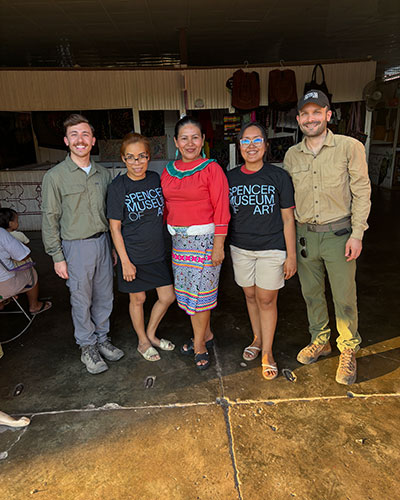
Third photo: Ryan Clasby (right) and Eli Troen with (left to right) Monica Cairuna Picota, Norma Maynas Fernandez, Irene Pernia, members of La Asociación de Artesanos Maroti Shobo in Yarinacocha, Peru.
Fourth photo: View of the Huallaga River, Yurimaguas, Peru.